Search built for researchers
Boolean quick search plus a visual Advanced Search builder for nested condition trees, with relevance ranking and term highlighting.
Every collection has its own structure — correspondence, photographs, ephemera, institutional records — and its own level of description. Librygo lets each one keep its own custom fields, with search precise enough for the researcher who already knows exactly what they're looking for.
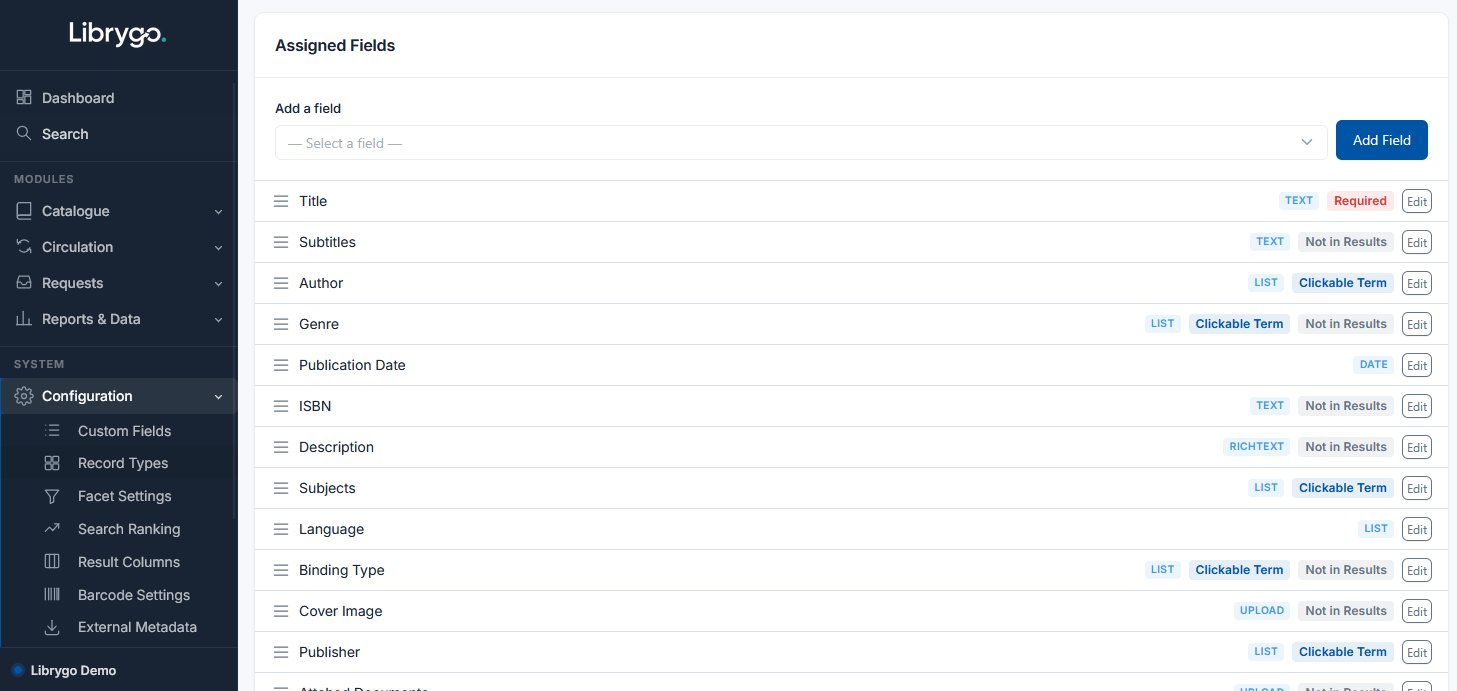
Define exactly the fields each series or collection needs — creator, date range, extent, condition, restrictions — without forcing a photograph collection into the same shape as a correspondence series. Rich text fields hold detailed finding-aid description; file and image fields hold the scans.
Boolean quick search plus a visual Advanced Search builder for nested condition trees, with relevance ranking and term highlighting.
Visualise how a letter connects to a collection, a person, and an event — links that a flat catalogue entry can't show.
Use Collections to represent series and sub-series, grouping related records without duplicating catalogue entries.
Open the portal to the public, restrict it to registered researchers, or keep it internal — your call, per organisation.
Remove and restore records without losing data permanently — useful when a description needs revisiting later.
Bring in existing records, including MARC21, and our team can help map them into your archival record types.
Managing objects as well as documents? See Librygo for Museums.
We'll walk through custom fields per collection, search, and portal access options for researchers.